Category: Uncategorized

  • Parent Tot Games and Songs

    Parent Tot Games and Songs

    Swim Lesson Games and Songs for Parent Tot Class

    We recently did a comprehensive podcast on this topic: SIP 006: Songs and Games for Parent Tot classes
    SIP-006-Artwork

    Sing the Hokey Pokey:

    Hokey Pokey together as a group. Put all floaty toys in the middle of a circle.

    You put your hands in, you put your hands out,

    you put your hands in and you paddle them about,

     you do the hokey pokey and you turn yourself around,

    that’s what it’s all about….

    You put your right arm in, you put your right arm out,

    you put your right arm in and you splash it all about,

    you do the hokey pokey and you turn yourself about

    that’s what it’s all about…

    You put your left arm in…

    You put your lips in…. …and you blow bubbles all about

    You put your hair in… …and you splash it all about

    You put your whole self in… …and you splash about

    The Hokey Pokey is a standard song and one most people are familiar with. We save it for the end of our classes and it makes an excellent end of lesson song.

    Each time you chose a body part to put in, place that in front of you and splash it about either gently or furiously. The instructor’s enthusiasm will dictate the energy parents and swimmers will put into the game/song too.


    Alligator, Alligator Song

    Hold your child’s hands with yours. Sing the following:

    “Alligator, Alligator, on the wall.

    Alligator, alligator, in you fall!”

    “One, two, three, go!”

    On “go” gently pull the child into a hug by lifting and pulling their hands towards you and then wrapping their arms around your neck.  Smile, laugh, and be happy.

    Restrict the depth the infant goes underwater. Limit the water to only go up to their shoulders. Keep the infant’s face above water as you gently pull them into the water and into your embrace.


    Motorboat, Motorboat

    . Parents hands over the baby’s hands.

    Encourage them to kick to toys, to the wall, to you.

    -Play Motorboat, Motorboat with the children. Have parents do it

    Too.

    Sing the following:

    Motorboat, motorboat, go so slow (drawn out)

    Motorboat, motorboat, go so Fast…..

    Motorboat, motorboat, STEP ON THE GAS!!!!

    For each stage of motorboat, move quicker as you sing. When you do “step on the gas!” move quickly and change your tone of voice.


    Twinkle Twinkle

    Sing this song while doing back floats and encourage the child to look into the ceiling and look for stars.

      Twinkle, twinkle, little star,
         How I wonder what you are.
         Up above the world so high,
         Like a diamond in the sky.

       Twinkle, twinkle, little star.
         How I wonder what you are.
         How I wonder what you are.


    Humpty Dumpty:

    Humpty Dumpty sat on a wall,
    Humpty Dumpty had a great fall.
    All the king’s horses and all the king’s men
    Couldn’t put Humpty together again.

    Play this game while having your child sit on the side of the pool. When you either finish, or when you say “had a great fall” hold the child’s hands and pull them into the water into your arms. You can play this game at the beginning of your swimming lesson too. Have everyone sit on the side and then sing the song for each participant. Pull them in or let them jump into your arms when you finish the song each time.


    https://youtu.be/8r1odhNFQfE?si=n1k5xOcreaLg2BTo

    I’m a little Teapot

    I’m a little teapot,
    Short and stout
    Here is my handle here is my spout
    When I’m all steamed up
    Hear me shout
    Tip me over,
    And pour me out!!!

    Alternate version of the song:
    I’m a little teapot,
    Short and stout,
    Here is my handle, here is my handle….
    Wait a minute… I’M A SUGARBOWL!

    During the lyrics of the song, you should pantomime the different characteristics of the “teapot”

    For “spout” and “handle” put your arms to your side: spout to your hip, and other arm out to the side. When you play the Sugarbowl version, put both hands at your hips.

    You can further amplify this song by pouring water on the swimmers in your group at the end of the song. When you get to, “pour me out” pour a bucket of water over your participant’s heads. You can also give them each their own buckets or pails and sing the song as a group. When you get to the end, everyone pours their own water out!


    Head and Shoulders Knees and Toes

    Head, shoulders, knees and toes, knees and toes

    Head, shoulders, knees and toes, knees and toes

    And eyes and ears and mouth and nose

    Head, shoulders, knees and toes, knees and toes

    Additional verses are sung by omitting the first word sung in the previous verse, and, instead, children touch their body parts, without actually saying the word. For example:

    Verse 2
    —-, shoulders, knees and toes
    Verse 3
    —-, —-, knees and toes
    Verse 4
    —-, —-, —- — toes
    Verse 5
    —-, —-, —- — —-

    This pattern continues until the children are silently touching their body parts in rhythm with the song. The last verse consists of no actual singing, just touching what would have been sung or repeating the first verse in a quicker tempo.

    You can play this game/song while having your swimmer sit on the edge of the pool where you point to different body parts with each verse. If your child doesn’t mind either, you can take a small bucket or cup and sprinkle water over the body part during the song. Pour water over the back of the head on “head,” over the shoulders on “shoulders,” and continuing to all parts. When you omit words you can have the swimmer pour water on themselves when they say the word, or you can pour water once they sing the lyric.

    Another adaptation is to kneel down in the water to that depth for each portion of the lyrics if you can bend or lower yourself that well or lift your swimmer up.

    • If you’re Happy and You know it

    If you’re happy and you know it, splash your hands!

    (splash water, splash water)

    If you’re happy and you know it, splash your hands!

    (splash water, splash water)

    If you’re happy and you know it, and you really want to show it;

    If you’re happy and you know it, splash your hands!

    (splash, splash)

    You can change the lyrics with each round. Here are some ideas!

    “… turn around!”

    “… snap your fingers!”

    “… bob your head!”

    “… blow some bubbles!”

    “… splash your face!”

    “… kick your feet!”

    “… splash your feet!


    Alphabet Song

    A, B, C, D, E, F, G…

    H, I, J, K, L, M, N, O, P…( “l, m, n, o,” spoken twice as quickly as rest of rhyme)

    Q, R, S…/ and T, U, V… (/kjuː ɑr ɛs, tiː juː viː,/ pause between s and t)

    W… X…/ and Y and/& Z. pause between x y, w and x last for two beats

    Now, I know my ABCs.

    Next time, won’t you sing with me?

    Alternate fun version: BACKWARDS!!!

    Z-Y-X-W-V-and-U–

    T-and-S-and-R-and-Q–

    P-O-N-M-L-K-J–,

    I-H-G-F-EDCBA– (EDCBA said like LMNOP in original alphabet song)

    Now I know my CBAs;Next time, won’t you lead the way?

    While singing the Alphabet song you can hold your child in the back glide or back float position where they can relax on their backs, or you can hold them in the front float or glide position. Either way works and we’re using the song to create a peaceful stimulating experience where participants are calm and enjoying the sound of their parent’s voice while also doing a float of some kind. Sometimes the song takes their mind of the fact that they ears are in the water, or their mouth is touching water.


    Row Row Row your Boat

    Row, row, row your boat,
    Gently down the stream.
    Merrily, merrily, merrily, merrily,
    Life is but a dream.

    Row, row, row your boat,
    Gently down the stream.
    If you see an alligator,
    Don’t forget to scream.
    Row, row, row your boat,
    Gently down the stream.
    Throw your teacher overboard
    And listen to her scream.
     
    Row, row, row your boat,
    Gently down the stream.
    Ha ha, fooled ya,
    I’m a submarine.
     
    Most of the time we play this song while doing back or front floats. With the additional ‘silly’ versions you can incorporate some fun and excitement beyond just the singing and joining in. When you say “See an alligator” have the other participants do Alligator walks and when you run into them after the float make sure you time it to the song. Encourage the participant to ‘scream.’ During the “ha ha, fooled ya, I’m a submarine” you can pull yourself underwater and if you have an advanced participant you can say, “Ready, Go!” and pull them under too.


    More Songs:


    We created Swim Lesson Plans for Parent Tot classes using these songs

  • Swimming Game – Duck Partner Kick

    This is a great game to play with both swim teams and swim lessons. Ideally your swimmers will be able to kick with a kickboard by themselves for more than 4 lengths.   Start at one end of the pool with everyone
    • Have swimmers form partners
    • Give 1 little rubber duck to each group
    • Swimmers must keep the duck on the kickboard any way they can while kicking
    • Swimmers are not allowed to use their hands from the wrist down
    • can use any other part of their body to either hold, or rescue their duck
    • 1 partner goes first and goes down and back
    • Pass the duck to the other partner without using hands
    • Second partner goes down and back
    • Continue for specified duration
    PROTIP!! You can say “we are doing a 400 partner kick!” This means that each swimmer will do a 50 at a time, with a total amount of 400 yards, where each swimmer does 200 yards.   PROTIP!! The easiest way of holding the duck is by squeezing with the elbows or forearms.   PROTIP!! Dictate which kicks are allowed, or remove the kickboard to increase difficulty!
  • Swimming Game – Treasure Hunt

    This swimming lessons game works best in a zero-depth pool; a pool that simulates a beach. There are a number of swimming skills that it works on, and many more depending on how creative your instructors or you are.

    Treasure Hunt:

    • Get a kickboard. This will be your “boat.”
    • Every child in your class is a pirate or a treasure hunter. The instructor is the Captain.  The captain steers the boat, the children go around it.
    • Instructor does an alligator walk while pushing the “boat.”
    • Children do alligator walks behind or around instructor and “boat” while hunting for treasure.
    • When instructor / Captain gets to a certain point, throw toys or rings, out into the water and have the pirates/children/hunters go find treasure.
    • Put rules on children, can only get treasure if they go underwater, or do a front float, or blow bubbles.
    • Bring 1 piece of treasure back to the boat at a time. Stack the treasure on the boat.
    • Alligator walk with bubbles on the way back, to help the boat laden with treasure move faster.
    • OPTIONAL! Run into a storm and lose the treasure and find it again with new activity: back floats/underwater 2x/etc.
    • Pull into harbor/where class began and give rewards for treasure; exmp: Buckethead!

    This game works REALLY well to do alligator walks, underwater, and blowing bubbles IF the instructor is willing to suspend their disbelief and play with the children.

    Excellent game for 2-5 years.

    Additional information added 4/3/2023:

    Swimming Lesson Game: Treasure Hunt

    Are you looking for a fun and effective way to teach your students how to swim? If so, you might want to try the treasure hunt game. This game is a great way to motivate your students, practice different skills, and have a lot of fun in the water. Here is how it works:

    How is it played?

    The treasure hunt game is simple to set up and play. All you need are some small objects that can sink to the bottom of the pool, such as coins, rings, or toys. You can also use pool noodles or kickboards to mark the boundaries of the treasure area. Before the game starts, scatter the objects in the designated area and make sure they are visible from the surface.

    To play the game, divide your students into two teams and assign them a color or a symbol. Each team has to collect as many objects of their color or symbol as possible within a certain time limit. You can also assign different points to different objects depending on their difficulty or value. For example, a coin might be worth one point, while a ring might be worth two points.

    The students can use any swimming technique they want to retrieve the objects, but they have to follow some rules:

    • They have to stay within the treasure area and not cross the boundaries.
    • They have to return to their team’s base (a wall or a lane marker) after each dive and place their object in a bucket or a basket.
    • They have to take turns diving and not interfere with the other team’s divers.

    The game ends when the time is up or when all the objects are collected. The team with the most points wins.

    Who is the game for?

    The treasure hunt game is suitable for students of different ages and levels. However, you should make sure that your students are comfortable with diving underwater and holding their breath for a few seconds. You should also adjust the depth and size of the treasure area according to your students’ abilities and safety.

    The game can be played with small or large groups, but you should try to balance the teams in terms of number and skill. You can also modify the game by adding more or less objects, changing the time limit, or introducing different challenges or rewards.

    What skills does it work on?

    The treasure hunt game is a great way to work on various swimming skills, such as:

    • Breath control: The students have to exhale underwater and inhale at the surface.
    • Diving: The students have to dive down to reach the objects.
    • Streamlining: The students have to keep their body in a straight line while diving and swimming.
    • Kicking: The students have to use their legs to propel themselves underwater and on the surface.
    • Arm strokes: The students have to use their arms to pull themselves underwater and on the surface.
    • Buoyancy: The students have to adjust their buoyancy to sink or float.
    • Coordination: The students have to coordinate their breathing, diving, swimming, and grabbing skills.
    • Endurance: The students have to swim back and forth between their base and the treasure area multiple times.
    • Teamwork: The students have to cooperate with their teammates and follow the rules.

    The treasure hunt game is a fun and effective way to teach your students how to swim. It can help them improve their skills, confidence, and enjoyment in the water. Try it out in your next swimming lesson and see how your students react!

  • Swimming Lessons Plan – Swim Lesson Plan Template

    Swimming Lessons Plan – Swim Lesson Plan Template

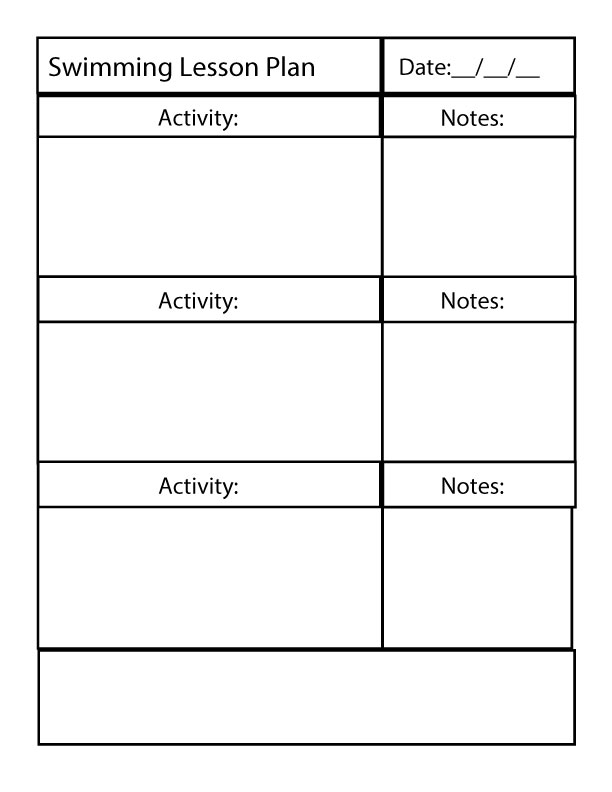
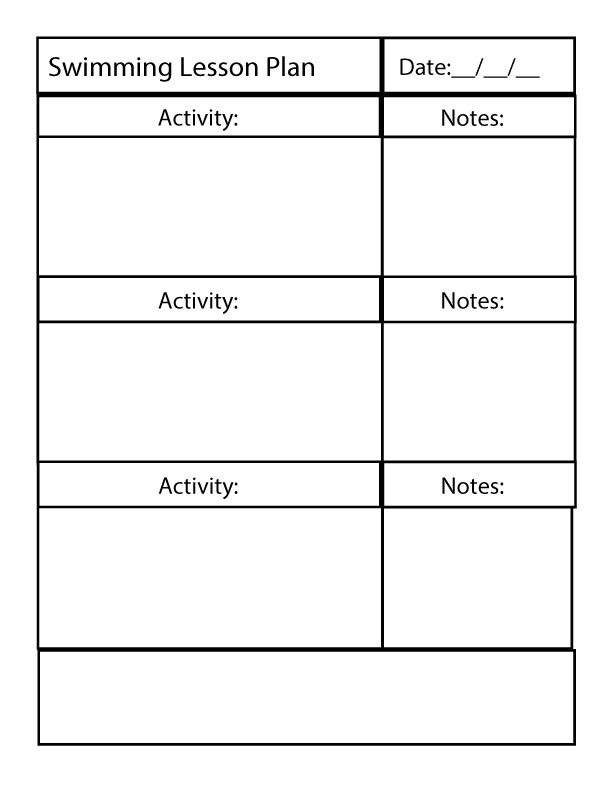
    Use the following generic template to write your own swimming lessons plans.

    Most lessons are 30 minutes, and you can break up your lessons into three 10 minute blocks. I generally focus on one skill like Freestyle in a 10 minute block, working on glides, streamlines, kicking and arms. After 10 minutes of that do 10 minutes of backstroke, then 10 minutes of games, jumps, underwater work.

    Good LUCK!

    Swim-Lesson-Plan1


    Want a real plan? Check out our store with high quality tested swim lesson plans designed to provide fun and effective swim games.

  • Swimming Game – Parent Tot – Hokey Pokey

    Swimming Game – Parent Tot – Hokey Pokey

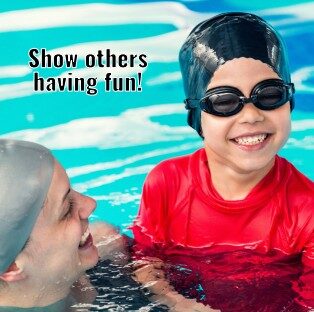
    "Put your whole self in!"
    Dancing in the pool

    Hokey Pokey For Parent Tot Swimming Lessons

    The best thing for infant swimmers is routine. Repetition, repetition, repetition, repetition. If you play the Hokey Pokey in your class, I suggest you do it at the end of your class session. It can be time consuming, and get monotonous and droll. Focus on a few key points.
    • Put your feet in and shake them all about. Starting with the feet will re-emphasize kicking that you ideally spent 1/2 your class time working on in some fashion. Remember! Babies/2.5 year olds are not able to fully move their bodies yet in those fine motor movements.
    • Put your Hand in, put your hand out! Focus on the reaching motion of the arm and the hand. We’re looking for macro movements (long large body motions, not cupped hands and s-curve pulling).
    • Put you whole face in and blow a bubble out! #1 goal of any preschool class?? Go underwater and make it as natural as possible.
    For limited time, and maximum effect, focus on only these three items in your song. Any more and you’ll waste valuable teaching time, and start dipping into the boring repetition of the song.   You put your [feet] in, You put your [feet] out, You put your[feet] in, And you shake it all about, You do the hokey pokey and you turn yourself around That what it’s all about. 2) left arm 3) right arm 4) Face 5) Whole Self (make it a little fun too 😀 )