Author: Jeff Test

  • Swim Lesson Toys and Games to play

    The toys to buy for your swimming lesson program

    These are the best swimming lesson toys that you can get for your swim lessons or swim lesson program. If you use American Red Cross, Starfish Aquatics, or Swim America, you’ll benefit from any or all of these swim lesson toys. Every game, song, or activity is possible, or made better by using these toys.

    [/vc_column_text][vc_empty_space][/vc_column][vc_column width=”1/2″][vc_column_text]

    Barbells

    [/vc_column_text][vc_single_image image=”1744″ img_size=”200×200″][/vc_column][vc_column width=”1/2″][vc_column_text]

    The toys to buy for your swimming lesson program

    These are the best swimming lesson toys that you can get for your swim lessons or swim lesson program. If you use American Red Cross, Starfish Aquatics, or Swim America, you’ll benefit from any or all of these swim lesson toys. Every game, song, or activity is possible, or made better by using these toys.

    [/vc_column_text][vc_empty_space][/vc_column][vc_column width=”1/2″][vc_column_text]

    Barbells

    [/vc_column_text][vc_single_image image=”1744″ img_size=”200×200″][/vc_column][vc_column width=”1/2″][vc_column_text]


    [/vc_column_text][/vc_column][/vc_row]

    [vc_row][vc_column][vc_column_text]Barbells are a versatile and excellent tool to use in your swim program. They hold the child at the surface and provide a stable and firm item to hold when they are doing their front crawl or back crawls. I personally like using barbells for certain situations instead of noodles because the barbells are more rigid and stiff. Noodles bend and give, and are not always ideal for true beginning swimmers.

    Most often, we use barbells in our swim lessons with the following activities:

    Flutter Kicking on Front

    Backstroke kicking (using barbell for support)

    Catchup Drill Front Crawl

    Here are some games that will help you use your barbells:

    Kick with Barbells

    You can make this a game or an activity for learning kicking. There are two main ways to hold the barbell.


    • Beginner Barbell hold
      • Place the barbell under the armpits and have the swimmer on top of it
      • Arms should reach forward
      • Legs should be on surface behind swimmer
      • Barbell will support the shoulders and armpits
      • Head will be raised, leaning forward.


    • Advanced Barbell hold
      • Hold barbell in hands
      • Extend arms forward over the head
      • Arms remain straight
      • Avoid elbows bending as much as possible
      • Face will be in the water, ideally looking down
      • can be modified to have lips in water or nose only
      • Feet and body should be flat and as straight as possible

    [/vc_column_text][/vc_column][/vc_row]

    Use the appropriate hold for each child tailoring your directions to the individual. If the swimmer is scared or does not put their face in the water they should do the Beginner barbell hold.

    [vc_row][vc_column][vc_column_text]


    Catchup Swim With Barbells

    Catchup is a drill primarily used for FREESTYLE. Swimmer moves in water in position 11 and does 1 armstroke at a time. The arm that is moving catches up to the other arm still extended over the head in front of the swimmer. Once the moving arm resumes position 11, then the other arm does an arm stroke. Instead of doing position 11 without support, have the swimmer hold the barbell with both hands. Do do Catchup drill, the swimmer will then move one arm at a time, having one hand always holding the barbell.

    • Reinforce body line
      • Spine straight
      • Legs mostly straight
      • Arms straight
    • Faceshould be looking down in the water.
      • Avoid looking up
      • Minimize breaths
    • When breathing keep 1/2 of face still in the water
    • Only breathe during an arm stroke


    Powerlifters

    This game is a little more advanced and for swimmers that will go underwater on their own.

    1. Do Kicking with Barbells to the deep end from their original location.
    2. Once at the deep end, have the swimmer hold the barbell in their hands.
    3. Still holding on to the barbell, go underwater and raise the barbell above your head
    4. Will look like an Olympic power lifter holding a barbell over head.
    5. Keep body straight
    6. Legs should be straight, under the person
    7. Will look like they are standing upright holding the barbell over their head.
    8. Pull down on the barbell like a pullup to come back to surface


    Get your own Barbells here: Water Gear Bar Float, Non-Padded

    Most Lesson programs will get about 10 – 20 depending on how large their program is.


    [/vc_column_text][/vc_column][/vc_row]

    [vc_row][vc_column width=”1/2″][vc_column_text]

    Buckets

    [/vc_column_text][vc_single_image image=”1747″ img_size=”200×200″][/vc_column][vc_column width=”1/2″][vc_column_text]

    [/vc_column_text][/vc_column][/vc_row]

    [vc_row][vc_column][vc_column_text]Buckets to use for swimming lessons Using buckets is the best way to get newer swimmers used to getting their head wet. Most children should be comfortable having water poured over their hair, shoulders, and chest. Typically they have experienced this at home with their daily washing. You’ll notice that the children that shower or bathe regularly with water over their face are more likely to go underwater in a swim lesson. For those that are not comfortable yet, we play Buckethead! Most children enjoy seeing water pour out of the bucket and get pleasure in pouring it on themselves, on the instructor, or on the other students.


    Buckethead – The Best Game Ever

    The game’s success lies with how enthusiastic the instructor is. If they excitedly yell “BUCKETHEAD” every time, then the game is met with excitement and laughter.

    Allay children’s fears of water on their face by offering 3 choices: 1) “Shoulderhead” – pourwater on their shoulders 2) Hair- Yell “Buckethead” but pour on their hair, they should look up slightly so the water falls down back. 3) BUCKETHEAD! Pour water all over their head and face.


    Fill a Bucket Game

    • Have one huge bucket on the side of the pool, or have 1 child hold the “Master Bucket.”
    • Give each swimmer a bucket, or rotate a second bucket
    • Each person gets to fill the 2nd bucket with water from the “well.”
      • Well =differentlocation nearby
        • Get there by swimming a specific stroke, or walking with bucket
        • Can put bucket on head, or on belly and kick on back
    • With filled 2nd bucket, return to “Master Bucket” and fill it up
    • Once Master Bucket filled, holding person has to:
      • Pour it over their head
      • Face plant into the bucket to “drink the water”


    Get your own buckets here: 12 Sand Pail Beach Play Sets, small 3.25″ Bucket w/Rake, Scoop and Shovel- 12 sets


    [/vc_column_text][/vc_column][/vc_row]

    [vc_row][vc_column width=”1/2″][vc_column_text]

    Diving Rings

    [/vc_column_text][vc_single_image image=”1752″ img_size=”200×200″][/vc_column][vc_column width=”1/2″][vc_column_text][/vc_column_text][/vc_column][/vc_row]

    [vc_row][vc_column][vc_column_text]If you walk into a pool outside, inside, anywhere you have a very good chance of stepping on a diving ring either in the pool or on the deck. These are a staple of swimming today. You can find all manner of diving rings: Sticks, sinkers, floating ones, colored, numbered. While their purpose is typically to go underwater and get them, we’ve found some creative ways to integrate them into your lesson through games and activities. One of those not listed below is using the rings as an aide for doing catchup drill. Have the swimmer hold onto the ring with both hands and then swim freestyle always having one hand hold the ring in front of them. You can have the swimmer hold on to the ring with both hands and do a streamline through a hula hoop pretending they’re super man.

    Diving rings can also be swimmer’s own personal cake mixers. Play Bake A Cake, and give each child their own “cake” to make inside each ring.

    Ring Retrieval

    Swim game where you throw the rings, or drop them nearby. Have the swimmers then go get them.

    Challenge mode: Front crawl to the rings, back crawl with the rings back to start area.

    You can help beginner swimmers in three ways:

    • Put the rings just under the surface so they can reach them without going underwater
      • can ask them to use their feet to lift it higher if they need it
    • Hold a swimmer’s hand as they go down a little deeper.
      • Instructor can help push them down, and lift them back up safely
    • Push their back and gently push them deep to the bottom and let go.
      • Swimmer will then get ring and jump back up to surface
      • Instructor can then assist them at the surface


    Treasure Hunt

    This is one of my favorite games to play and it works best in a zero depth pool. You can do a variety of things with this game and its strength is how well the instructor creates the scene with their words and actions. Play pretend and it will be a blast!

     Get your own diving rings for your swim program now: Intex Underwater Swimming/Diving Pool Toy Rings – Assorted Colors


    [/vc_column_text][vc_separator][/vc_column][/vc_row]

    [vc_row][vc_column width=”1/2″][vc_column_text]

    Diving Sticks

    [/vc_column_text][/vc_column][vc_column width=”1/2″][vc_column_text][/vc_column_text][/vc_column][/vc_row]

    [vc_row][vc_column][vc_column_text]Most games you play with rings can also be played with the diving sticks. I find it is nice to have a variety of toys available.

    Throw and Get

    Throw all the diving sticks around the pool area. If you have a beginner keep them closer to the starting area.

    1 swimmer then has 30 seconds to get as many as they can. If you have the rings featured here, you can then count how many points they earned.

    The person that gets the most points wins!


    Get your own Diving Sticks here: Swimline Flex-Sticks Dive Game


    [/vc_column_text][/vc_column][/vc_row]

    [vc_row][vc_column width=”1/2″][vc_column_text]

    Diving Torpedo

    [/vc_column_text][/vc_column][vc_column width=”1/2″][vc_column_text][/vc_column_text][/vc_column][/vc_row]

    [vc_row][vc_column][vc_column_text]The Diving torpedo is one of the most fun toys in the water. It is weighted so when you drop or push it, it goes through the water like a torpedo or a missile. Swimmers love going underwater and throwing it to each other, or throwing it and going to get it.

    Hit the Target

    Set up a hula hoop a few feet away. It can be horizontal laying on bottom, or vertical suspended by someone or weights.

    Goal is to throw the torpedo shark through or on the target.

    This can be very challenging because the torpedo does not always go straight, and can sometimes move very quickly or go off course due to water currents.


    Get your own Diving Torpedo toy here: Swimways Dive ‘N Glide Shark


    [/vc_column_text][/vc_column][/vc_row]

    [vc_row][vc_column width=”1/2″][vc_column_text]

    Hula Hoops

    [/vc_column_text][vc_single_image image=”222″ img_size=”200×200″][vc_single_image image=”1782″ img_size=”200×200″][/vc_column][vc_column width=”1/2″][vc_column_text][/vc_column_text][/vc_column][/vc_row]

    [vc_row][vc_column][vc_column_text]Most games involve going through the hula hoop in some fashion. You can hold the hula hoop at the surface and have beginners walk through the hoop to do something fun. Lower the top of the hoop so they have to put their face in the water in order to go through. You can require certain “Tolls” in order to pass through: Lips in water. 3 bubbles, Nose wet, an ear in the water, etc.


    Bake a Cake

    This is one of my favorite games to play after Buckethead. The game is mostly focused on using the hula hoop as a giant mixing bowl. The more energy the instructor puts into the pretend world, the better the results. Make sure you move quickly through each part.


    Streamline through Hula Hoop

    Play this game with your more advanced swimmers. Have one person hold the hula hoop vertically on the bottom from the side. Other person does a streamline underwater through the hula hoop. Avoid looking and guess where the hoop is!


    Glide through Hula Hoop

    For beginners, have them stand on a platform or in chest deep water. Hold the hula hoop vertically and have 1/2 above the water. Swimmers then go through the hoop ideally on their bellies or on their backs, though they can walk and jump through too.


    Superman through Hula Hoop

    Pretend you are super man and you’re flying through the hula hoop. Throw hands forward and “fly” through the hoop held vertically.


    Ring around the Rosie

    Have everyone grab the sides of the hoop and hold it on the surface in a circle.

    Sing the song, Ring around the Rosie, and then all go underwater at the end.

    “Ring-a-round the rosie,

    A pocket full of posies,
    Ashes! Ashes!

    We all fall down.”


    Like these games? Get your own Hula Hoops here: Classic Hula Hoop Set of 3


    [/vc_column_text][/vc_column][/vc_row]

    [vc_row][vc_column width=”1/2″][vc_column_text]

    Kickboards

    [/vc_column_text][vc_single_image image=”1775″ img_size=”200×200″][vc_single_image image=”1780″ img_size=”200×200″][vc_single_image image=”587″ img_size=”200×200″][/vc_column][vc_column width=”1/2″][vc_column_text][/vc_column_text][/vc_column][/vc_row]

    [vc_row][vc_column][vc_column_text]Swim teams use kick boards. Lap swimmers love kickboards, and generally, if you’re at the pool there is a stack of jumbled kick boards somewhere in a corner or closet.  Kick boards are generally used to build an aerobic base in kicking, or getting used to the repetitive kicking motion by solely kicking a lot. In lessons, we use boards to help aide newer swimmers learning how to kick without sinking under the water. We can also use it as a tool to play games and help swim different strokes.

    Legs on Fire

    Great game to play with your group of more advanced swimmers.

    Relay Race

    Play a relay race with the kickboards. 1 kickboard per team, they need to hand off the board to the next person in the relay.

    You can even have 1 person kicking and 1 person pulling the same board.


    Slalom

    Play with different items in the pool as the flag posts, or put people there and the swimmer has to kick around them in a zig zag pattern


    Catchup Swim with Board

    Swim Catch up drill with the kick board out in front of the swimmer’s head.

    1 hand stays locked on the kick board the whole time, other hand does an arm stroke.

    Focus on kicking and keeping head down when not taking a quick breath.

    Partner Sandwich with Board

    Form partners. Each person has 1 board. The partners sandwich the board vertically and kick on their sides across the pool. Kickboards must remain sandwiched together horizontally / vertically as they go

    Turtle Swim

    Use the boards in this creative game!

    Treasure Hunt with Board

    Use the kickboard as the pirate ship, or the explorer’s ship. Have swimmers go on expeditions and find treasure. When they return they have to balance it on the kickboard. Be careful of waves it might capsize the ship and all the treasure will be lost!!!


    Enjoy these games?  Outfit your swim team or your lesson program with either of these boards: TYR SPORT Kickboard
    Speedo Adult Kickboard (Black)


    [/vc_column_text][/vc_column][/vc_row]

    [vc_row][vc_column width=”1/2″][vc_column_text]

    Noodles

    [/vc_column_text][vc_single_image image=”1779″ img_size=”200×200″][/vc_column][vc_column width=”1/2″][vc_column_text][/vc_column_text][/vc_column][/vc_row

    The Noodle is probably the most versitle and best toy that you can possibly get in a pool and a swim lesson program. You can use it for almost anything. Starfish aquatics us their guard tubes like noodles, and most swim instructors have some sort of aide and drill or activity that they use the noodle for. If there is one item on this list you’re unsure of, this is not it. Buy the noodles.

    Noodle Race Partners

    Relay race with partners and with noodles. Give a free ride, push or pull.

    Hold behind back and work on Breaststroke Kick

    Lay on the noodle with it under the arm pits and look at your breaststroke kick. This is more a drill than a game. Do 10 scissors with the knees straight, then do 10 BR kicks. Make sure your swimmer is always LOOKING at their feet while doing this. You’ll see a huge improvement in your struggling breaststroke kick swimmers.
    Child in water laying on back relaxing on noodles
    Child in water laying on back relaxing on noodles

    Ride the Bull

    Your swimmer will hold onto the noodle any way they can. Instructor then drags them around the pool quickly in a wobbly noodle pattern trying to dislodge them from the noodle and make them fall off. Go in fast circles, buck the noodle wildly.

    Make a Raft

    Stack or bundle as many noodles as you can and lay across them all. Then have someone else push swimmer around. Switch off.

    Pretzel Float / Swim

    If your noodle is large enough, wrap it around the waist and then tie it in a pretzel shape. Swimmer will have their own personal floaty. Be careful! A noodle is not a safe swimming aid alone. Be sure to supervise as pretzel can come undone quickly.
    14272871666_5a3e3ecd5f_o

    Tandem Kick

    Find a partner. Stand in line both facing same direction. Hold 1 noodle in same hand. Both partners hold 1 noodle in their right hands, and they each hold the other noodle in their left hand. Swimmers kick. Noodles are like parallel bars.

    Need some noodles of your own? Buy these! Tundra Water Noodles (12-Pack)

  • Swimming Game – Fly and Back

    Swimming Game – Fly and Back

    What Swimming Skill will be the focus? Flatter surface fly, and pressing down with arms extended Explain the game in detail. What gives a challenge to everyone, but allows for failure? Relay race. Everyone will get a chance to compete, and be part of the team. Put toys at the bottom of the pool just beyond the ½ way mark. Divide swimmers into lanes and equal numbers inside each lane. Swimmers go 1 at a time in a Relay Race. Each swimmer does quick, fast, on the surface FLY swim to ½ way. When they reach ½ way, they dive down to the bottom with their hands above their heads in Position 11 immediately after they complete their last FLY stroke (with hands hitting the water in front of them, extended). Upon reaching the bottom, swimmers pick up a toy, and kick BACKSTROKE back to the wall, holding their toy on their belly with 2 hands. The team that finishes first is the winner.     Victory Conditions:
    • Team who finishes first in true relay style
    • Team with the most toys collected. Swimmers may participate multiple times. Go until all toys picked up from bottom.
    DQ’s for people that go down underwater too early, or who don’t swim legal FLY.     If someone DQ’d, throw the toy back to past ½ way. [Tweet “Everyone gets a chance to compete in this Fly Game”] [GARD] What can we do to force the swimmers to interact while attempting the skill? Encourage that they cheer for each other. Talk about what got them DQ’d and help each other remember specifics of FLY swim. Forgetting streamline is a good thing to DQ on and the competition will lead to lane discussion and help remembering each time they go. What are the clear, obvious, examples of success and failure? Success: Legal Fly, quality streamline, properly going to the bottom: arms extended forward and doing fly kick to toy. Kicking on back with 2 hands on toy until the wall (1 hand above head to touch wall acceptable) Failure: Illegal FLY swim: free kick, deep strokes, bent arms, non-simultaneous arm recovery, poor quality streamline, doing FREE kick, using arms on Backstroke Kick to propel faster.
    • If swimmer is DQ’d, throw the toy back to past ½ way
      • If playing RELAY style, the whole relay is DQ’d at the end
      • If playing until toys are gone, then the toy is replaced by the DQ’d individual.
    [Tweet “If playing Relay style, then whole relay is DQ’d at the end”] How can the activity be explained the simplest? Split up the lanes into equal swimmers in each lane. Put either:
    • Equal number of toys on the bottom of pool just past ½ way as there are swimmers
    • More toys than there are swimmers on the bottom of the pool just past ½ way
    One person in each lane will go at a time. Swimmer will do Streamline, then FLY swim to ½ way. Goal is to swim quick and fast on the surface of the pool. Once you get to ½ way, after your last fly stroke, keep your hands above your head extended and do fly kick to the bottom of the pool. Pick up a toy, push off bottom, and do BACKSTROKE kick back to the wall. Must have 2 hands holding the toy on your stomach. Once swimmer with toy reaches the wall, next swimmer goes. Must do legal FLY swim, a good quality streamline with 3 goals: 1) Thumb locked 2) Ears squeezed 3) looking down. On Back Kick, must have 2 hands on toy until the end where 1 hand up to touch wall is acceptable. Victory Conditions:
    • 1st relay to finish wins
    • When all the toys are gone, the team with the most toys at the wall wins.
  • Swimming Game – Glide through the Hula Hoop

    What Swimming Skill will be the focus?

    Breaststroke Glide

    What can we do that gives a challenge to everyone, but allows for failure?

    Have one person hold a Hula Hoop and have another swimmer do 2 strokes BR by a certain point and then hold the GLIDE through the hula hoop. Possibly have 3 people with hula hoops stationed down the lane and right before they get to the circle, the swimmer needs to hold a strong GLIDE through the hoop and beyond the standing teammate. Focus on the extended GLIDE

    [Tweet “What can we do to force the swimmers to interact while attempting the skill?”]

    What can we do to force the swimmers to interact while attempting the skill?

    Have some hold hula hoops, have others swim. Rotate through so everyone gets a chance to participate.


    [GARD]

    What are the clear, obvious, examples of success and failure?

    Success: Making it through the hoop without moving any part of body. If Swimmer touches the hula hoop with a body part = DQ / Fail If swimmer moves body while inside the hula hoop (any part of body) = DQ / Fail.

    How can the activity be explained the simplest?

    Get 3 hula hoops.

    1st 3 people in lane each take one hula hoop. Station them at 1st Yellow, 1/2 way, and last yellow. Hold hula hoop vertical so you can swim through the hoop. Hold the top of the hoop just above the water.

    1 swimmer will swim BR for 1 length and go through each hoop.

    There is no moving your body when you are inside a hoop.

    If you move while inside a hoop you get DQ’d. Hold a long GLIDE while going through hoop.

    Try to swim focusing on the glide and holding it into a long body line. If you touch a hoop with your body you will be DQ’d.

    Need to go through middle of hoop.

    Once swimmer has touched the wall, they will take the closest hoop, and shift the swimmers holding hoops towards the start point. Rotate until everyone has had a chance to play.

    [Tweet “Great BR Drill / Game to play for #swim team”]

  • Why “Mr. Fox” is the worst swim game you can play

    If you are not familiar with the game, check this out: wikipedia on “Mr. Fox” Basically: – swimmer 1 stands away from the others, who typically remain on the wall. -Swimmer 1 waits while others chant: “Mr. Fox, Mr. Fox, what time is it?” -Swimmer 1 then shouts, with their backs turned to the others, “#:00 o’clock” – Other swimmers then do that number of kicks, strokes, or other things to get closer to swimmer 1. – Instead of answering a time, the “Fox” can say, “Dinner Time!” and swim after the other swimmers and attempt to tag them before they get back to the wall or start point. -The first other swimmer to touch Swimmer 1 with back turned is the winner.   There are a few very obvious problems with this game for swimming.

    #1 Only effective in the shallowest of shallow ends.

    Remember, these are swim lessons. We are teaching young children how to swim, and each minute is paid for by their parents. We must do this game in the shallow end because there are long moments of no motion or movement while asking “what time it is” and waiting for other swimmers to stop their number of motions. Because of these long delays, we need to allow the swim lesson participants to stand because they largely don’t know how to swim! and likely don’t know how to tread water. We must do this activity so they can stand and breathe during the game’s built in downtime. If your pool does not have a shallow end where all participants can stand, do not play this game.

    #2 Long downtime wastes time.

    Parents are paying for their children to be in swim lessons. In some cases we may excuse what seems like time wasting on repetitive action, but this game does not satisfy any justification for time wasting with a worthy skill focus. A game like Bake a Cake, has moments were the swimmers are doing nothing while waiting for other kids to make an ingredient decision, but our ultimate goal with that game is water comfort, instructor connection, going underwater, and learning the “feel of the water” by mixing. In Mr. Fox, we see the swimmers waiting around doing nothing, standing or floating on their own. While they may be required as a condition of the game to kick their feet or do a certain stroke, the time spent in between is too long with little or no focus on a goal or specific stroke style.

    #3 The ratio of swimming strokes or kicks to time spent is too low.

    In Mr. Fox, you have perhaps 3 -4 opportunities to swim or kick to the Fox after a lengthy wait doing nothing. If we were to do 1 freestyle arm stroke to the Fox for each hour of time, the participants may only be getting 3-6 arm strokes in a 4 minute round of the game. Instead, we could have the child throw a ring to the instructor, swim to the instructor w/ 4 armstrokes, get the ring, then swim back for another 4 strokes, within about 1 minute. We can rotate through the kids, and in 5 minutes, likely get everyone in twice for a total of about 16 freestyle strokes versus the 3-6 possible in 5 minutes of Mr. Fox.

    #4. The quality of the swimming is sloppy, ineffective, and not the controlled motions we’re attempting to teach.

    Most young children will swim or kick when they want to go fast in the water using what they know, or think will make them move. They have their experiences to tell them that they can move faster doing an illegal, or incorrect breaststroke kick (scissors kick) instead of a slower correct breaststroke kick. Or maybe they are very good doggie paddlers, and will do that instead of putting their head down, kicking their feet and doing quality freestyle. As an instructor, at what point do you stop the game to correct strokes for each child? More likely you’ll be consumed with enforcing game rules like not moving during the waiting periods. You are wasting valuable teaching time and effort on inconsequential actions.

    Don’t waste your time, and the parent’s $

    Our goal as a swim teacher is to instill these specific strange and new body motions to young children (or adults) through repetitive actions (think classical conditioning).  Playing this game wastes time in waiting, encourages sloppy or poor technique to “get there faster,” wastes your valuable effort by enforcing game rules instead of correcting stroke technique, and can only be effectively played in super shallow pool. Use our website, pick a different game, and next time you see this awful game being played, complain to your swim lesson manager.
  • Swimming Game – Choice Grid

    Use your chalkboard, whiteboard, or poster and create a grid on it.  
    Activity 1 3x streamline + 3 strokes Free Activity 2 3x streamline + 2 fly strokes no kick Activity 3 3x streamline + 3 BK strokes Activity 4 3x streamline + 2 BR strokes
    10 Flips 10 Handstands 10 Streamline Jumps 10 Handstands that turn into flips
    4×25 FLY K 4×25 FR K 2x 50 BK 1×100 BR
    Float on back from bottom to surface Put nose, belly button and 1 big toe on bottom for 2 seconds 3x Do 5 second front float, then flip 5x Find place in lane to do 3 creative streamlines
      Here is an example grid that you could use. Notice how it is a mix of games, workouts, short distance skill work. (more…)
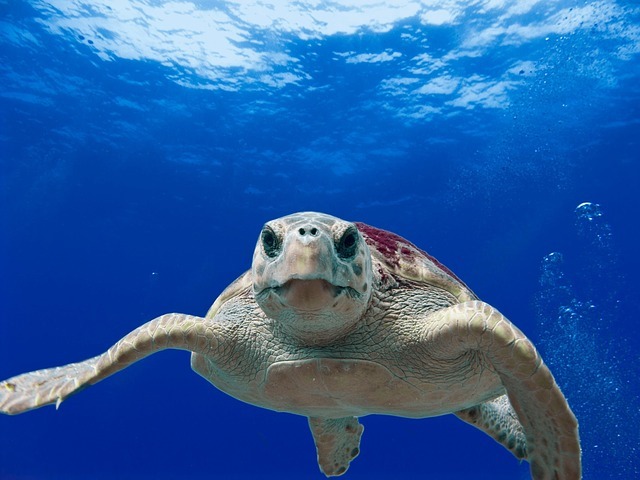
  • Swimming Game – Turtle Swim

    Swimming Game – Turtle Swim

    loggerhead-turtle-123402_640

    Group swimming lesson or swim team game.

    One player gets a kickboard puts one toy on top of it. Player then floats on back with kickboard balanced on their stomach like it is a turtle shell.

    Goal is to get to the other side without toy falling off the kickboard, or his shell falling off.


    Other players can do 1 of two things, depending on skill level. They can be boulders in the water and block the turtle from their goal, but cannot move.


    They can pretend to be other turtles and without using their hands try and steal the toy and put it on top of their kickboard.


    Other players can be sharks and after a head start, chase down the turtle, but can only tag their head.


    Other players can create a current, or rapids by waving kickboards underwater or just at the surface to make it difficult for the turtle to get by without dropping the toy, or sinking under the waves.

  • Swimming Game – Legs on Fire

    Swim Game – Legs on Fire

        Have all your swimmers get kickboards. Get into one lane or an open large area. Get 1 bucket and fill with water. All but 1 swimmers starts an easy kick set. Waiting swimmer not participating is the Fire Truck. Coach/Instructor gives an item to one of the kickers and declaires that their LEGS ARE ON FIRE! The Fire Truck must kick sprint to the Legs on Fire swimmer and use the bucket to “put out the fire.” The Fire Truck swimmer should have the bucket on top of their kickboard making sure not to spill any water. Each child gets a chance to be the Fire Truck. Ideal game for a 50 meter pool, or for novice swimmers.
  • Swimming Game – Parent Tot – Hokey Pokey

    Swimming Game – Parent Tot – Hokey Pokey

    "Put your whole self in!"
    Dancing in the pool

    Hokey Pokey For Parent Tot Swimming Lessons

    The best thing for infant swimmers is routine. Repetition, repetition, repetition, repetition. If you play the Hokey Pokey in your class, I suggest you do it at the end of your class session. It can be time consuming, and get monotonous and droll. Focus on a few key points.
    • Put your feet in and shake them all about. Starting with the feet will re-emphasize kicking that you ideally spent 1/2 your class time working on in some fashion. Remember! Babies/2.5 year olds are not able to fully move their bodies yet in those fine motor movements.
    • Put your Hand in, put your hand out! Focus on the reaching motion of the arm and the hand. We’re looking for macro movements (long large body motions, not cupped hands and s-curve pulling).
    • Put you whole face in and blow a bubble out! #1 goal of any preschool class?? Go underwater and make it as natural as possible.
    For limited time, and maximum effect, focus on only these three items in your song. Any more and you’ll waste valuable teaching time, and start dipping into the boring repetition of the song.   You put your [feet] in, You put your [feet] out, You put your[feet] in, And you shake it all about, You do the hokey pokey and you turn yourself around That what it’s all about. 2) left arm 3) right arm 4) Face 5) Whole Self (make it a little fun too 😀 )
  • Swimming Lessons Plan – Swim Lesson Plan Template

    Swimming Lessons Plan – Swim Lesson Plan Template

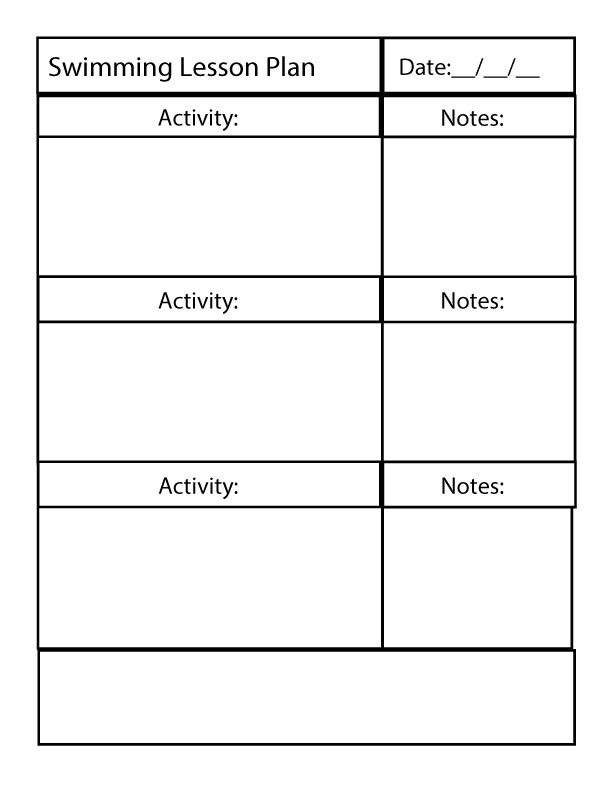
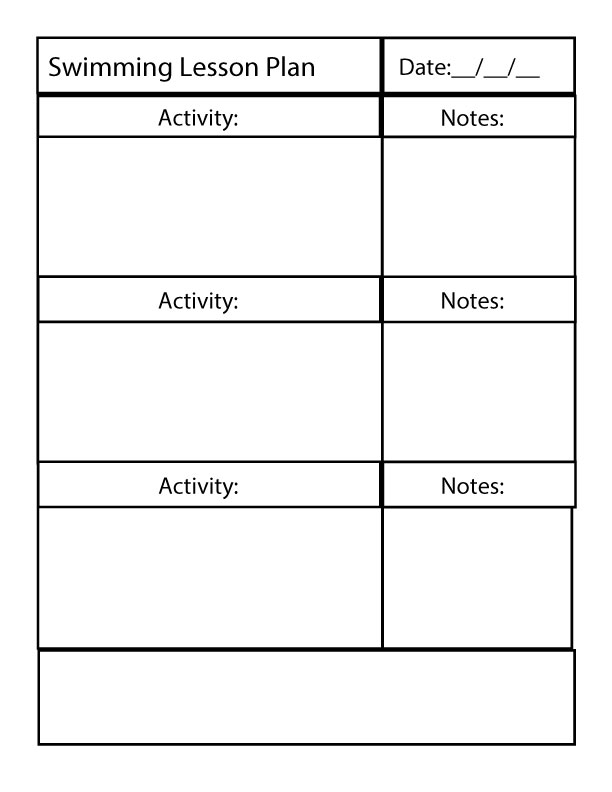
    Use the following generic template to write your own swimming lessons plans.

    Most lessons are 30 minutes, and you can break up your lessons into three 10 minute blocks. I generally focus on one skill like Freestyle in a 10 minute block, working on glides, streamlines, kicking and arms. After 10 minutes of that do 10 minutes of backstroke, then 10 minutes of games, jumps, underwater work.

    Good LUCK!

    Swim-Lesson-Plan1


    Want a real plan? Check out our store with high quality tested swim lesson plans designed to provide fun and effective swim games.

  • Swimming Game – Treasure Hunt

    This swimming lessons game works best in a zero-depth pool; a pool that simulates a beach. There are a number of swimming skills that it works on, and many more depending on how creative your instructors or you are.

    Treasure Hunt:

    • Get a kickboard. This will be your “boat.”
    • Every child in your class is a pirate or a treasure hunter. The instructor is the Captain.  The captain steers the boat, the children go around it.
    • Instructor does an alligator walk while pushing the “boat.”
    • Children do alligator walks behind or around instructor and “boat” while hunting for treasure.
    • When instructor / Captain gets to a certain point, throw toys or rings, out into the water and have the pirates/children/hunters go find treasure.
    • Put rules on children, can only get treasure if they go underwater, or do a front float, or blow bubbles.
    • Bring 1 piece of treasure back to the boat at a time. Stack the treasure on the boat.
    • Alligator walk with bubbles on the way back, to help the boat laden with treasure move faster.
    • OPTIONAL! Run into a storm and lose the treasure and find it again with new activity: back floats/underwater 2x/etc.
    • Pull into harbor/where class began and give rewards for treasure; exmp: Buckethead!

    This game works REALLY well to do alligator walks, underwater, and blowing bubbles IF the instructor is willing to suspend their disbelief and play with the children.

    Excellent game for 2-5 years.

    Additional information added 4/3/2023:

    Swimming Lesson Game: Treasure Hunt

    Are you looking for a fun and effective way to teach your students how to swim? If so, you might want to try the treasure hunt game. This game is a great way to motivate your students, practice different skills, and have a lot of fun in the water. Here is how it works:

    How is it played?

    The treasure hunt game is simple to set up and play. All you need are some small objects that can sink to the bottom of the pool, such as coins, rings, or toys. You can also use pool noodles or kickboards to mark the boundaries of the treasure area. Before the game starts, scatter the objects in the designated area and make sure they are visible from the surface.

    To play the game, divide your students into two teams and assign them a color or a symbol. Each team has to collect as many objects of their color or symbol as possible within a certain time limit. You can also assign different points to different objects depending on their difficulty or value. For example, a coin might be worth one point, while a ring might be worth two points.

    The students can use any swimming technique they want to retrieve the objects, but they have to follow some rules:

    • They have to stay within the treasure area and not cross the boundaries.
    • They have to return to their team’s base (a wall or a lane marker) after each dive and place their object in a bucket or a basket.
    • They have to take turns diving and not interfere with the other team’s divers.

    The game ends when the time is up or when all the objects are collected. The team with the most points wins.

    Who is the game for?

    The treasure hunt game is suitable for students of different ages and levels. However, you should make sure that your students are comfortable with diving underwater and holding their breath for a few seconds. You should also adjust the depth and size of the treasure area according to your students’ abilities and safety.

    The game can be played with small or large groups, but you should try to balance the teams in terms of number and skill. You can also modify the game by adding more or less objects, changing the time limit, or introducing different challenges or rewards.

    What skills does it work on?

    The treasure hunt game is a great way to work on various swimming skills, such as:

    • Breath control: The students have to exhale underwater and inhale at the surface.
    • Diving: The students have to dive down to reach the objects.
    • Streamlining: The students have to keep their body in a straight line while diving and swimming.
    • Kicking: The students have to use their legs to propel themselves underwater and on the surface.
    • Arm strokes: The students have to use their arms to pull themselves underwater and on the surface.
    • Buoyancy: The students have to adjust their buoyancy to sink or float.
    • Coordination: The students have to coordinate their breathing, diving, swimming, and grabbing skills.
    • Endurance: The students have to swim back and forth between their base and the treasure area multiple times.
    • Teamwork: The students have to cooperate with their teammates and follow the rules.

    The treasure hunt game is a fun and effective way to teach your students how to swim. It can help them improve their skills, confidence, and enjoyment in the water. Try it out in your next swimming lesson and see how your students react!